
When the AI Bubble Bursts, What Will Still Be Worth Learning?
The valuations attached to frontier-model companies will not rise forever. If they correct, the useful question for engineers is not whether AI disappears, but which parts of the stack remain worth understanding.
Kingsley Ijomah
AI Adoption Lead
Updated
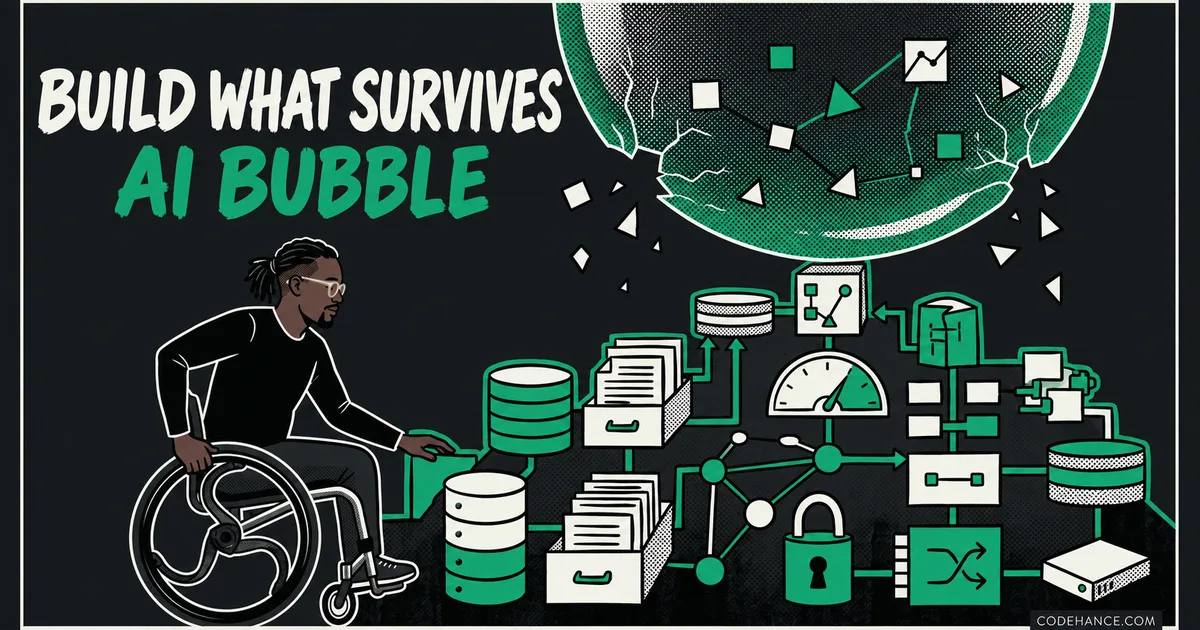
I started looking into the AI bubble because the valuations had become difficult to ignore.
OpenAI raised $122 billion in 2026 at an $852 billion post-money valuation. Anthropic announced a $65 billion round at a $965 billion valuation. Around them, cloud providers, data-centre operators and infrastructure funds have been committing still more money to the compute, buildings and power needed to keep the model race moving. OpenAI's funding announcement and Anthropic's funding announcement provide the round sizes and implied valuations.
My first explanation was too simple. I treated a rising valuation as if it were money the company had earned, and I treated the accompanying debt as if it sat neatly on the same balance sheet. Neither is true. A private funding round sets an implied price for the company. Much of the debt sits elsewhere in the ecosystem: hyperscalers, data-centre companies, special-purpose vehicles, utilities and private-credit structures.
The correction made the argument more interesting, not less.
The companies that own the frontier models represent the financial story of AI, but they do not contain everything the AI movement has built.
Their valuations will not compound at the current rate forever. That does not tell me when prices will correct, how far they will fall or which companies will survive. It tells me that choosing what to learn by following the most valuable model company is a poor strategy.
If you are an engineer deciding where to place your time, the useful question is not, “Which model owner will win?” It is, “What will companies still need when capital becomes more selective, models become cheaper and investors start asking for returns?”
That is where I think the durable implementation layer matters.
The bubble can burst without the technology failing
There are two arguments that often get confused.
The first is that AI has produced useful technology. The second is that the companies currently associated with it deserve every part of their present or anticipated valuation. The first can be true while the second turns out to be false.
The European Central Bank made a similar distinction in its analysis of technological booms. It found US market valuations close to their historical peak and argued that a correction should be expected even if current enthusiasm is rational. New technologies create extreme uncertainty. Investors price the possibility of very large future profits, then later demand a higher risk premium as the technology spreads and the risks become economy-wide. A correction does not require the technology to stop working.
This is why I am less interested in predicting the date of a crash. The timing is unknowable in advance. I am more interested in what current prices require us to believe.
They require model owners to turn astonishing adoption into durable margins. They require infrastructure built today to produce enough future revenue to service long-lived obligations. They require customers to convert experiments and individual productivity gains into changes visible on an income statement.
Some will. The uncomfortable question is whether enough of them will do it quickly enough.
The financial pressure is spreading beyond the model owners
OpenAI and Anthropic are useful representatives of the AI industry because they sit at the centre of the story. Their models attract users, enterprise demand and investor attention. But looking only at their accounts would miss where much of the financial risk is accumulating.
The Bank of England reported that five AI hyperscalers represented about 3% of outstanding US investment-grade debt at the end of 2025, but more than 15% of issuance by early May 2026. It also cited an OECD estimate that private credit's share of AI investment financing rose from 9% in 2024 to 34% in 2025. The same report describes declining free cash flow, special-purpose vehicles and off-balance-sheet arrangements spreading exposure through banks, private-credit funds and insurers.
The model company creates the expectation. The surrounding system finances the capacity required to fulfil it.
That difference matters. A model owner can lose paper value quickly. A long lease, bond, power agreement or data-centre loan does not disappear at the same speed.
The ROI picture is not empty, but it is incomplete. An NBER survey of nearly 6,000 executives across the United States, United Kingdom, Germany and Australia found that nine in ten reported no effect from AI on their firm's employment or productivity during the preceding three years. Executives still expected modest gains over the next three years. Other studies have found positive effects in particular occupations and workflows.
The honest claim is therefore not that AI produces no return. It is that adoption and investment have moved faster than measured, economy-wide returns.
That gap can close through rising productivity. It can also close through lower valuations, cancelled projects and losses. A bubble argument is really an argument about which side of that gap moves first.
Owning the best model may be a temporary advantage
The model owners face another problem: the asset receiving the enormous valuation can depreciate remarkably quickly.
A frontier model may lead at release and be matched months later. Stanford's 2025 AI Index found that the cost of achieving roughly GPT-3.5-level performance fell from $20 to $0.07 per million tokens between November 2022 and October 2024. Its 2026 report says the performance gap between the leading US and Chinese models had effectively closed.
Better and cheaper models increase the usefulness of AI. They do not necessarily increase the amount of profit captured by one model owner.
This changed how I thought about the bubble. The technology can improve so quickly that it weakens the scarcity on which the highest valuations depend. If several providers offer sufficient capability, customers can route work between them, use smaller models for bounded tasks or run open models themselves.
The durable advantage then moves away from the model weights. It moves towards distribution, customer relationships, proprietary workflows, operational data, cost control and the ability to make the model reliable inside a real system.
I reached a related conclusion while asking who will own the agentic stack. The model is one control point. Runtime, data, identity, evaluation and the business workflow are others. A financial correction would make those boundaries easier to see because every dependency would have to justify its cost.
The implementation layer is what the boom is leaving behind
When I looked beneath the valuations, I found a much larger body of work than RAG and vector databases. The boom has accelerated a set of engineering capabilities that solve problems independent of which model is leading this month.
Not every company selling those capabilities will survive. Some categories will consolidate. Some features will be absorbed into existing platforms. What persists is the problem being solved and the engineering knowledge required to solve it.
Data that models can actually use
Production AI has forced organisations to confront the condition of their data. A model cannot compensate reliably for documents that are obsolete, duplicated, inaccessible, incorrectly permissioned or detached from their source.
The durable work includes ingestion, extraction, metadata, lineage, entity resolution, access control, retention and deletion. It includes turning PDFs, emails, recordings, images, tables and legacy files into information a system can retrieve without losing their structure or authority.
This is not glamorous model work. It is what determines whether a generated answer is connected to the current policy or to a superseded copy somebody forgot to remove.
Knowledge graphs also belong here. Retrieval can find related passages, but many domains need explicit relationships between customers, accounts, contracts, products and obligations. A model may interpret an ambiguous request; a governed data layer still has to establish which entity the request concerns and what the user is allowed to know about it.
The lasting asset is not “more data”. It is data that is current, attributable, permission-aware and usable by software.
Retrieval that is more than a vector database
RAG was introduced by Facebook AI researchers in 2020 as a way to combine a generator with retrieved external knowledge. The recent boom made the term mainstream, but the underlying requirement is older and broader: applications need to find relevant information that was not fixed inside a model's parameters.
That requirement remains when a model changes. A company still needs current prices, private policies, customer records and evidence that can be cited or inspected.
Vector search is one part of that system. Production retrieval increasingly combines semantic similarity with keyword search, filters, recency, source status, reranking and abstention. PostgreSQL can add vector similarity through pgvector. MongoDB combines vector, full-text and structured retrieval in the same operational platform. The capability is being absorbed into ordinary databases.
This leads to a distinction I would keep in mind when deciding what to learn: vector retrieval is durable; the valuation of every standalone vector-database company is not.
I explored the implementation consequences in RAG Beyond the Demo. Chunking, conflicting sources, deletion and evaluation mattered more than placing an array of numbers in a database. Those are transferable retrieval lessons even if the database, embedding model and generator all change.
Context, memory and state
A useful AI application has to know more than the latest prompt. It may need a user's role, the current task, previous decisions, unresolved questions, tool results and a record of what has already happened.
Context engineering is the work of deciding what enters the model, what stays outside it, what gets retrieved, what is summarised and what must never be exposed. Longer context windows do not remove that responsibility. Sending everything is expensive, slow and dangerous when different users have different permissions.
Memory and state make the problem more concrete. A workflow that pauses for approval must resume from the correct point. An agent that retries an action must not charge a customer twice. A support assistant should remember the case without inventing facts from an unrelated conversation.
This is conventional systems work meeting a probabilistic component. State machines, queues, idempotency, retries and audit records remain useful even when the word “agent” becomes less fashionable.
Evaluation, observability and evidence
Traditional tests can tell us whether a function returned the expected value. AI systems also need tests for behaviour that may vary between runs.
That creates durable work around task-specific datasets, retrieval metrics, factual support, human review, regression testing, latency and cost. A new model release is not an automatic upgrade. It is a candidate that has to be tested against the work.
Observability follows the same logic. When an answer is wrong, the team needs to know whether the failure came from ingestion, retrieval, context selection, the model, a tool, permissions or an external service. A trace of the final response is not enough. The intermediate decisions matter.
This is one reason I argued that AI workflows should be model-agnostic. Own the brief, context and checks. Let a model earn its place against them. That becomes more important after a correction because teams will have to replace expensive dependencies without losing the behaviour they understand.
Security, identity and human approval
Connecting a model to tools creates new attack surfaces: prompt injection, malicious documents, data leakage, excessive permissions and actions taken under the wrong identity.
The durable implementation layer therefore includes authentication, authorisation, short-lived credentials, transaction limits, audit logs and human approval before consequential actions. NIST's generative-AI profile extends its AI Risk Management Framework specifically because these systems introduce risks that ordinary application controls do not cover completely.
Guardrails are not magic correctness wrappers. Their useful role is narrower: restrict what a failure can reach, detect known unsafe conditions and make sensitive decisions reviewable.
If investment slows, this work does not become optional. The opposite is more likely. Companies under pressure to show returns will need to move beyond demonstrations, and production systems require stronger boundaries than demonstrations do.
Interoperability and model portability
Open protocols are another residue of the boom. The Model Context Protocol standardises a boundary between AI applications and external tools or data. Agent2Agent addresses communication between independent agents. Both moved under Linux Foundation governance, supported by companies that otherwise compete across the AI stack.
The exact protocols may evolve, but the need is durable. Organisations do not want to rebuild every integration when they change models.
A model gateway serves a related purpose. It can route a difficult task to a frontier model, a simple classification to a smaller model and sensitive work to a local environment. It can enforce budgets, fallbacks and usage policies across providers.
Portability should not become a purity test. A provider-specific capability can be worth using. The engineering skill is knowing which dependency you accepted, what measurable improvement it provides and how the rest of the system behaves if that provider changes its price, model or terms.
Efficient inference and smaller models
Abundant investment rewards scale. Scarce investment rewards efficiency.
Quantisation, distillation, batching, caching, model routing and efficient serving all reduce the cost of producing a useful result. Smaller specialised models can handle classification, extraction, moderation and repetitive tool use without sending every request to the most expensive frontier model.
On-device inference extends the same idea. PyTorch's ExecuTorch supports models running on phones, computers, wearables and embedded devices. Local execution can reduce latency and cloud cost, work without a network connection and keep sensitive data on the device.
These capabilities may become more valuable after a bubble because the question changes from “How much compute can we acquire?” to “How much useful work can we produce from the compute we can justify?”
Workflow and product design
The final durable layer is closest to the user.
A model response is not a business outcome. Value appears when the response changes a workflow: a support case is resolved, a document is processed, a developer finds a defect, a clinician receives useful evidence or a customer completes a task.
That requires product discovery and process design. Teams need to decide which judgement can be probabilistic, where deterministic rules still apply, when a person must intervene and how success will be measured.
Natural-language interfaces, document extraction, semantic search, voice interaction, coding assistance and multimodal processing will not all retain the AI label. Many will become expected features of normal software.
This is the larger point behind what Building with AI means for software engineers. The model matters, but the work is in the behaviour of the system around it.
Some infrastructure will survive, and some will become wreckage
The physical build-out deserves a more careful answer.
The boom is leaving data-centre buildings, fibre connections, substations, cooling systems, high-capacity networks and people who know how to operate dense computing infrastructure. Much of that can be reused.
But installed capital is not automatically valuable capital. A data centre can be built in the wrong location. A power contract can outlast its tenant. Accelerators can become obsolete faster than the debt used to finance the facility. Infrastructure designed around one assumption about model scale may be awkward to repurpose.
The same warning applies to software. A generic chatbot wrapper is not durable because it uses an LLM. An agent framework is not durable because it has a fashionable abstraction. A vector database is not durable merely because it stores vectors.
Durability comes from solving a recurring problem in a way that remains useful when the model, vendor and funding environment change.
What I would learn before the market becomes less forgiving
If I were organising a learning path around what survives, I would not begin with a list of AI products. I would build one bounded system and learn the following through it:
- Data lifecycle. Ingest a real source, preserve its structure and metadata, update it, permission it and delete every derived copy.
- Retrieval. Compare keyword, vector and hybrid search. Add reranking. Test missing, conflicting and obsolete evidence.
- Evaluation. Create representative cases before changing models. Measure usefulness, failure, latency and complete task cost.
- State and workflow. Make a multi-step task survive retries, partial failure and human approval without repeating harmful actions.
- Tools and permissions. Connect one useful capability through a clear interface. Give it the minimum access required and record what it does.
- Observability. Preserve enough of each run to explain where a failure entered the system.
- Portability. Replace the model and identify what breaks. Keep the context, tests and workflow under your control.
- Efficiency. Route simple work to a smaller model, cache repeated work and measure whether the expensive step improves the outcome.
This path is deliberately less exciting than trying every new model. It is also more likely to compound.
You will learn why a fluent answer can hide failed retrieval. You will see how permissions change tool design. You will discover that an evaluation set is more valuable than a provider leaderboard when a model changes. You will have something you can still operate if a favourite vendor disappears.
A correction would move value down the stack
I do not know whether the current cycle ends in a dramatic crash, a slow repricing or enough real growth to justify more of today's valuations. Nobody does.
I am confident about a narrower claim. The upward value assigned to model ownership cannot be the only thing worth learning from this period.
If valuations correct, capital will become more demanding. Projects will need measurable outcomes. Expensive model calls will need cheaper alternatives. Generic demonstrations will give way to systems that can retrieve the right evidence, respect permissions, survive failure and show why they deserve to exist.
That is not the death of AI. It is the point at which AI stops receiving value merely for being AI.
Learn the parts of the system that become more important when money gets expensive.
Models will change. Valuations will change faster. Data quality, retrieval, evaluation, security, orchestration, cost control and accountable product decisions will still be waiting underneath.
Sources
Linked so you can check the financial evidence, technical claims and their limits.
- OpenAI: Accelerating the next phase of AI. Supplies the company's 2026 announcement of $122 billion in committed capital at an $852 billion post-money valuation. It is a first-party funding announcement and does not independently establish that the valuation will produce a corresponding return.
- Anthropic: Series H funding announcement. Supplies the $65 billion round and $965 billion post-money valuation used in the opening. It is Anthropic's account of its growth and financing rather than an independent assessment of profitability or fair value.
- European Central Bank: The AI boom, rational enthusiasm or the next dot-com bubble?. Provides the August 2026 analysis of elevated valuations and why technological revolutions can experience corrections even when the underlying technology succeeds. The timing and path of any correction remain unknowable in advance.
- Bank of England: Financial Stability Report, July 2026. Supplies the figures on hyperscaler investment-grade issuance, private-credit growth, declining free cash flow and off-balance-sheet structures. Its immediate financial-stability assessment is cautious: the outstanding AI debt stock began 2026 at a relatively modest level, while risks were building rapidly.
- NBER: Firm Data on AI. Reports a 2026 survey of nearly 6,000 executives across four countries in which nine in ten saw no employment or productivity effect during the preceding three years, while expecting modest future gains. These are executive reports and economy-wide averages, not proof that individual AI deployments produce no return.
- Stanford HAI: Artificial Intelligence Index Report 2025. Provides the estimate that the inference cost for GPT-3.5-level MMLU performance fell from $20 to $0.07 per million tokens between November 2022 and October 2024. Benchmark-equivalent performance and API price do not capture every difference in model quality or product value.
- Stanford HAI: AI Index Report 2026. Supports the claim that the measured capability gap between leading US and Chinese models had become very small. Benchmark convergence does not mean the models, ecosystems or commercial positions are interchangeable.
- Lewis and colleagues: Retrieval-Augmented Generation for Knowledge-Intensive NLP Tasks. Supplies the 2020 research origin of RAG as generation combined with retrieved external knowledge. Its experimental system is not a performance claim for modern production RAG implementations.
- pgvector: vector similarity search for PostgreSQL. Demonstrates that vector storage and nearest-neighbour search can be incorporated into an established relational database. Project availability supports the convergence argument, not a claim that PostgreSQL is the correct vector system for every workload.
- Linux Foundation: Formation of the Agentic AI Foundation. Documents vendor-neutral governance for MCP and the participation of competing model, cloud and infrastructure companies. Governance and industry support do not guarantee that every protocol or implementation becomes a lasting standard.
- NIST: AI Risk Management Framework. Supports the discussion of operational governance and the generative-AI-specific risk profile. The framework provides voluntary risk-management guidance rather than a complete security implementation or legal compliance guarantee.
- PyTorch Foundation: ExecuTorch becomes part of PyTorch Core. Documents the 2026 move of the on-device inference runtime into PyTorch Core and its support for mobile and embedded deployment. It establishes the project's direction and scope rather than comparative performance for a particular device.
- MongoDB: Vector Search overview. Documents vector search, semantic retrieval, hybrid search and metadata filtering in an operational database. It is product documentation and does not establish that MongoDB is the right retrieval system for every workload.
- Linux Foundation: Agent2Agent Protocol project. Documents A2A as an open protocol for communication between agents across systems and platforms. A common protocol reduces bespoke integration work but does not make agent state, permissions or behaviour portable automatically.
Share this article
Pass it on to someone who might find it useful.
From theory to practice
See how the ideas become working systems.
I’m working on hands-on examples and videos that build real agentic workflows step by step. Join the list for new articles, practical material, and the first course updates when they’re ready.
Discussion
What did this make you think about?
Share what you have seen in practice, ask a question, or add a different perspective.